
What Bezos' $18 Billion Bet Really Means for Mechanical Engineers
Most AI stories aimed at engineers feel slightly detached from the real job. They talk about productivity and "10x workflows" — not tolerance stacks, design reviews, failed prototypes, supplier constraints or that uncomfortable moment when the simulation looks clean and the test rig says otherwise.
That is why Prometheus is worth paying attention to.
Not because it has solved engineering. It has not. Not because it is about to replace mechanical engineers. There is no evidence for that. Prometheus matters because it is one of the first heavily funded AI companies pointing directly at the hard part: the messy loop between design intent, physical behaviour, validation and manufacture.
What Prometheus has said — and what it has not
In June 2026, Prometheus announced a $12 billion Series B at a valuation of around $41 billion, following a $6.2 billion Series A seven months earlier. Jeff Bezos and Vik Bajaj — scientist, entrepreneur, previously of Verily and Foresite Labs — are co-founders and co-CEOs. The stated mission is unusually blunt: to build an "artificial general engineer." In their CNBC interview, the two described a system aimed not at text generation or image synthesis, but at accelerating the design and production of complex physical products.
That shift matters. Software AI can be impressive while carrying a low cost of failure. Physical engineering is not like that. A bad answer in a chatbot is embarrassing. A bad answer in a pressure vessel, actuator, turbine blade or medical device becomes expensive, dangerous, or both.
Bezos has talked about compressing engineering cycles by a factor of ten. His example was not a bracket or phone case — it was a jet engine improvement cycle that currently takes years. Even if that target proves optimistic by half, it tells you where the ambition sits. Prometheus is not trying to save an engineer five minutes hunting a command in CAD. It is going after the slow, expensive, iterative centre of industrial product development.
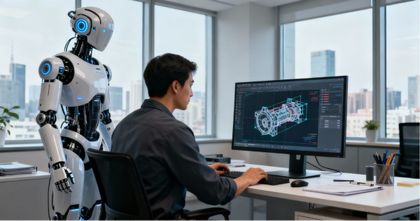
The phrase "artificial general engineer" is doing a lot of work. It implies something more ambitious than a geometry generator, simulation wrapper or automated design-rule checker. It suggests AI systems capable of reasoning across the design-build-test loop: exploring options, predicting physical behaviour, learning from manufacturing data and shortening development cycles. Whether that is achievable is a different question. The direction is real.
At the time of writing, though, Prometheus has not publicly demonstrated a product that mechanical engineers can evaluate. No customer case study, no published validation study, no benchmark against existing CAD or CAE workflow. That does not mean the company is empty — early industrial AI work often stays behind closed doors because useful data is proprietary, commercially sensitive and inseparable from real manufacturing processes. It does mean we should be careful with the language. The company has funding, a serious leadership team, and a large stated ambition. What it does not have is public engineering proof.
Mechanical engineers are trained to distrust unsupported performance claims. We do not accept a material data sheet without conditions. We do not trust an FEA plot without checking constraints, mesh quality and load paths. The same discipline applies here.
The team and the technical direction
Prometheus has around 150 employees across San Francisco, London and Zurich — a small headcount for a $41 billion valuation, which works out to roughly $120 million of capital per person.
Late last year, Wired reported that the company had acquired General Agents, an agentic AI startup co-founded by Sherjil Ozair and William Guss, with backgrounds spanning DeepMind, Tesla and OpenAI. More recently, Prometheus has hired Kyle Kosic, previously at OpenAI and xAI, along with engineers from Microsoft, Meta, Anthropic, Nvidia and others.
The General Agents acquisition is worth dwelling on, not for the names but for the direction. Agentic AI means systems that can plan, act and iterate — not just respond to prompts. In an engineering context, that could eventually translate to something that does not simply suggest a concept but works through a sequence: design checks, simulation runs, manufacturability constraints, documentation steps. Note the word "eventually." Engineers should be particularly cautious about demos that show a clean, isolated task. Real engineering workflows are not clean. A design change touches drawings, BOMs, supplier quotes, tooling, inspection plans, FMEA documents and sometimes certification evidence. An AI agent that impresses in a controlled demo may still fall apart in a real product development environment.
The spending breakdown tells its own story. The majority of the new $12 billion raise is earmarked for compute infrastructure. Bezos has said the work is "very compute intensive." That signals deep simulation training, not workflow automation bolt-ons.
Why physical engineering is harder than chatbot AI
Language models benefited from an enormous public training set. The internet was sitting there, messy but available. Engineering is different.
The most valuable engineering data is locked inside companies. It lives in CAD models, simulation archives, test reports, process sheets, supplier deviations, non-conformance records and the institutional memory of experienced engineers who know exactly why Rev C changed in 2018 but never wrote it down properly. Even where the data exists, it is rarely clean, consistent or easy to combine.
Manufacturing adds another layer. Machine settings, tool wear, inspection results, environmental conditions and operator notes all determine whether a part can be made repeatably. Two designs that look equivalent in CAD may behave very differently once they hit casting, machining, additive or assembly.
Then there is simulation. Simulations are structured approximations of reality. Boundary conditions matter. Material models matter. Contact assumptions matter. Correlation with physical test data matters most of all. "AI for engineering" cannot mean generating plausible-looking geometry. Plausible geometry is cheap. Verified geometry is expensive.
That may be Prometheus' real opportunity. If it can combine simulation, manufacturing data and AI-driven exploration into a genuinely reliable engineering workflow, it could shorten the painful loop between idea, prototype and validated product. But "reliable" is doing the heavy lifting in that sentence. In engineering, intelligence is not just producing an answer. Intelligence is knowing how much confidence that answer deserves.
The manufacturing angle may be the bigger story
In March 2026, Reuters reported that Bezos was in the early stages of raising a separate $100 billion fund to acquire and modernise manufacturing companies using AI. That is not the same as Prometheus announcing products, and it should not be treated as confirmed operational progress.
But strategically it makes sense, because the bottleneck for physical AI is not compute — it is data. Useful, structured, high-quality engineering and manufacturing data tied to real outcomes. If you want to train AI systems that understand how designs behave in production, owning or closely partnering with manufacturing businesses gives you something no public dataset can provide: the design decision, the process route, the inspection result and the failure mode in the same record.
This is why the "artificial general engineer" may look less like ChatGPT for CAD and more like a vertically integrated industrial platform. CAD, simulation, manufacturing feedback, inspection data and field performance all feeding one learning system.
That sounds powerful. It also sounds extremely difficult — anyone who has tried to clean up a PLM migration after ten years of inconsistent naming conventions will understand why. Now imagine doing that across multiple factories, product lines and engineering disciplines while claiming the system can accelerate design decisions. The prize is large precisely because the problem is ugly.
The incumbents are not standing still
Prometheus is entering a market where established engineering software companies already have deep workflow access — and that matters more than AI investors sometimes acknowledge.
Mechanical engineers do not adopt new tools because they look impressive at launch. They adopt tools that fit within existing constraints: CAD standards, drawing release processes, simulation methods, PLM systems, supplier communication and quality procedures.
Siemens, Dassault Systèmes, Autodesk, PTC and Ansys already sit inside those workflows. Siemens is promoting AI-enabled features in NX including a Design Copilot for analysis, optimisation and generation within the design environment. SOLIDWORKS has been moving in a similar direction with AI companions including AURA and LEO. Autodesk Fusion has long had generative design and topology optimisation. Onshape has been experimenting with AI assistance in a cloud-native CAD and PDM context.
None of these are artificial general engineers. They are more modest than that. But they have an advantage Prometheus does not yet have: proximity to daily work. The best engineering tool is not always the most advanced tool. It is the one a team can trust, validate, document and use without breaking the release process.
Prometheus may eventually leapfrog the incumbents by building a deeper AI-native stack. Or it may discover that engineering teams, under schedule pressure and facing change control, choose boring reliability over spectacular promises.
The near-term winners are unlikely to be systems that try to replace engineering judgement. They will be systems that remove friction around exploration, checking and iteration while keeping accountability firmly with the engineer. Less dramatic. Considerably more believable.
Where this technology could genuinely help
There are several areas where capable physical AI could become useful in a realistic timeframe.
Design-space exploration. Engineers often settle on a narrow set of concepts because there is not enough time to explore alternatives properly. AI-driven tools could generate and screen more options against load cases, mass targets, packaging constraints and manufacturing limits before the engineer decides where to focus.
Simulation acceleration. Many projects are slowed by the time and cost of running enough analyses to cover operating conditions adequately. Surrogate models and AI-assisted simulation workflows could help teams test more possibilities earlier — though faster simulation can also produce faster nonsense if the setup is poor.
Design-for-manufacture checks. Wall thickness, draft, tool access, minimum radii, tolerance risk and assembly access are all areas where AI could flag problems earlier in the cycle. Any engineer who has received a supplier response along the lines of "we can make it, but not like that" will understand the value.
Documentation. The least glamorous but possibly the most immediate opportunity. AI can help prepare design histories, summarise change rationales, consolidate test evidence and check consistency across drawings and reports. It will not make the headlines, but it could recover meaningful time.
The bigger leap — closed-loop learning from physical test and production data — is where Prometheus appears to be aiming. If an AI system can learn not just from idealised simulations but from how parts actually perform in test rigs, factories and the field, it starts to become relevant in a way that no current tool quite manages. But that also brings validation requirements that grow in proportion to the ambition. An AI-generated design option is a candidate. The engineer still has to understand the assumptions, interrogate the result and decide whether the evidence is good enough to release.
AI can suggest. Engineers must validate.
Who is most exposed, and who is not
The engineers most exposed to AI displacement are probably not doing the most creative or ambiguous work. They are doing highly repeatable analysis in well-defined domains with good historical data. Repetitive sizing calculations, standardised simulation sweeps, routine tolerance studies, drawing checks and variant generation against known design rules. These tasks are valuable, but they are structured enough for automation to bite.
The least exposed work is harder to formalise. Failure investigation. Early product definition. Trade-offs between performance, cost, serviceability and risk. Conversations with customers who do not yet know what they need. Understanding why a technician ignores a beautifully written assembly instruction because the actual access angle is impossible.
That kind of engineering is learned through projects, mistakes and exposure to real hardware. The safest engineer is not the one who refuses AI tools — it is the one who knows enough to challenge them.
In practice that means improving simulation literacy, understanding manufacturing processes more deeply, getting comfortable with data and becoming genuinely good at validation. The engineer who can combine AI tools with sound judgement will be more useful than the one who treats the tool as either magic or a threat.
Good engineers have always been defined less by how quickly they produce an answer than by how well they understand what could make that answer wrong. That habit becomes more valuable, not less, in an AI-heavy workflow.
What to watch over the next two to three years
Product shape. If the first release is a simulation accelerator or workflow assistant, that is still useful, but it is closer to the existing direction of CAD and CAE vendors. If Prometheus demonstrates a credible closed-loop system linking design generation, simulation, manufacturing feedback and physical validation, that is a different category of tool entirely.
Customer evidence. A private demo is one thing. A named industrial customer using the system on a real component is another. For mechanical engineers, the most convincing proof would be a case study showing measurable reduction in development time without sacrificing validation quality.
Safety-critical credibility. Prometheus has mentioned aerospace and medical devices. Those sectors are not governed by enthusiasm — they are governed by certification, traceability, verification and liability. Any serious move into those areas will require showing how AI-assisted decisions are documented, reviewed and controlled. That is where the marketing language will meet the engineering paperwork. The paperwork usually wins.
Acquisition activity. If the reported $100 billion manufacturing fund begins making confirmed purchases, watch which sectors and which processes Bezos targets first. That will tell you more about the technical roadmap than any press release.
The line worth holding
Prometheus may become a serious engineering platform, or it may become another reminder that physical reality is less forgiving than a pitch deck. Either way, the direction is clear. AI is moving from office productivity into the engineering stack, and the companies with the capital to train on physical systems are now taking direct aim at the design-build-test loop.
That does not make mechanical engineers obsolete. It means the job is shifting. Value will move away from producing routine outputs and towards framing problems well, validating results rigorously, understanding physical constraints and making accountable decisions. The best engineers will use these tools to explore more options, test assumptions earlier and catch problems sooner. The worst use of AI will be to generate confident answers that nobody has properly checked.
Prometheus is asking a serious question: can AI learn enough about the physical world to become a useful engineering partner? The honest answer, right now, is cautiously sceptical. It might help us move faster. It might help us search wider. It might even shorten some of the most painful development loops in modern engineering.
But until an AI system can stand up to test data, manufacturing reality and certification scrutiny, it remains an assistant, not an engineer.
That is the line worth holding.