
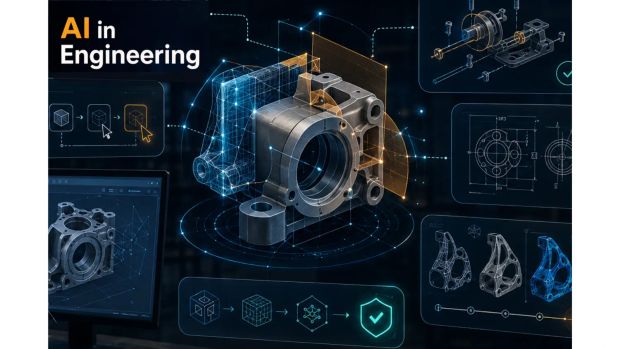
This week’s AI engineering brief looks at how AI is moving from general design assistance toward CAD geometry, modelling workflows, design review and simulation-led concept development.
1. Design: Autodesk Points AI at CAD Geometry
Autodesk is positioning neural technology as a new class of AI foundation models trained on professional design data and CAD geometry. The first proof point is neural CAD, which Autodesk says can reason directly about CAD objects rather than simply adding a chatbot layer onto existing design software.
For mechanical design teams, the interesting part is neural CAD for geometry in Fusion. Autodesk says it will be able to create editable, precision CAD geometry from text prompts and spatial constraints, and can also generate the parametric command sequence needed to build the part. In plain terms, that means AI could help produce actual CAD features, not just sketches or vague concepts.
The takeaway is that Autodesk is aiming AI at the core geometry engine of CAD. That could speed up early design exploration, especially for curved consumer-product forms and mechanical parts with defined faces and edges. But editable geometry still needs engineering discipline: dimensions, constraints, manufacturability, tolerances and design intent will remain the engineer’s responsibility.
Read more here.
2. Research: MIT VideoCAD Learns CAD Workflows
MIT researchers have developed VideoCAD, an AI system that learns to create 3D CAD models from 2D sketches by watching step-by-step CAD workflows. The team built a dataset of more than 41,000 examples showing how CAD objects are created through mouse clicks, drags, keyboard actions and software commands.
The important shift is that this agent does not just generate a shape as an image or mesh. It learns how to operate CAD software in a more human-like way, selecting tools and carrying out the build sequence needed to create a 3D object. MIT says the work could support future CAD copilots that suggest next steps, automate repetitive modelling sequences and help new users climb the CAD learning curve faster.
The takeaway for engineers is that AI is starting to move closer to actual CAD execution, not just design advice. That could help with repetitive modelling and early concept development, but it is still early. Real engineering CAD still needs constraints, assemblies, tolerances, design intent and manufacturability checks. The model may learn the clicks, but engineers still need to own the design logic.
Read more here.
3. Tools: SOLIDWORKS 2026 Targets Design Friction
Dassault Systèmes has announced SOLIDWORKS 2026, with AI features aimed at drawing creation, assembly work, knowledge search and collaboration. The release includes hundreds of updates across design, simulation, electrical and product data management, with tighter links into the 3DEXPERIENCE platform.
The most practical AI update is automatic recognition and assembly of fastener-like components, such as nuts and bolts, plus AI support for drawing creation and detailing. SOLIDWORKS 2026 also adds an AI-powered virtual companion that can summarise community posts, wikis, questions and ideas to help users find relevant knowledge faster.
The takeaway is that SOLIDWORKS AI is being aimed at everyday design friction rather than full design automation. Faster drawings, cleaner assembly workflows, better command search, large-assembly selective loading and improved change traceability all point to productivity gains. Engineers still need to own design intent, fits, tolerances, release control and manufacturability.
Read more here.
4. Tools: CoLab Adds AI to Design Review
CoLab’s latest product updates push AI deeper into design review, especially for 2D drawings. 2D AutoReview now uses a wider “factory” of specialised agents covering areas such as GD&T, tolerancing, dimensioning, fasteners, view integrity and BOM consistency, rather than relying on one general-purpose reviewer.
The practical detail is that engineers can now give AutoReview extra context before it runs, such as material, process, operating environment or specific checks to prioritise. CoLab has also added visible processing stages, so users can see which agents are running and what they are analysing, which should make AI review feel less like a black box.
There are also useful non-AI updates for review workflows, including wall thickness analysis directly on 3D models, model merging across different CAD sources, CSV feedback import and an enterprise API. The takeaway: CoLab is positioning design review as a connected, AI-assisted quality gate, but engineers still need to verify findings, resolve trade-offs and decide what is actually acceptable for manufacture.
Read more here.
5. Design: Neural Concept Targets Geometry and Physics
Neural Concept has launched an AI Design Copilot that combines spatial reasoning, physics awareness and CAD-ready geometry generation. It is designed to turn high-level design intent into virtual 3D geometry in minutes, helping engineers explore more options before detailed CAD and CAE work.
The company claims engineers can explore 10 to 1,000 times more design variants per iteration, link results into multi-physics workflows, and reduce manual workload by up to 90%. Target use cases include thermal, CFD, crash and electromagnetic simulation in sectors such as automotive, aerospace, energy and electronics.
The takeaway: Neural Concept is pushing AI toward early engineering decision-making, not just CAD assistance. It may widen the design search space, but engineers still need to validate the physics, manufacturability and final design choices.
Read more here.
Found this briefing useful?
Subscribe for concise, practical updates on AI tools, workflows and signals shaping engineering design, simulation and manufacturing.