1. Career: AI Moves Into Workflow Gaps
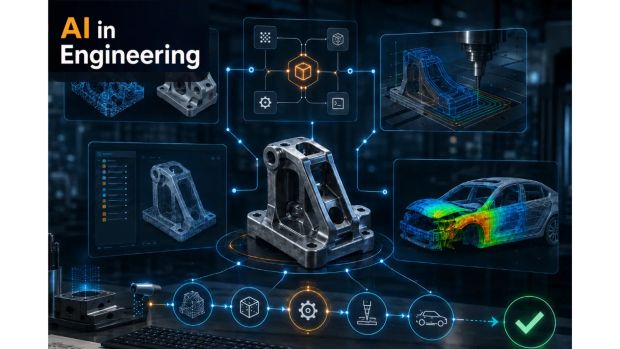
This issue shows AI moving into the messy middle of engineering work: CAM edits, scan-to-CAD clean-up, automated design workflows and early crash screening. For instance, Mastercam Copilot targets feed, speed and toolpath edits, while Synera is connecting Fusion and nTop into automated engineering workflows.
Short term, engineers who can steer and check AI-assisted tools will benefit most. That means knowing when a CAM suggestion is safe, when scan-to-CAD geometry is trustworthy, and when Luminary’s Shift-Crash is useful for early screening rather than final crash validation.
The career message is practical: the value is shifting toward engineers who can connect tools, question outputs and validate decisions. AI may speed up the workflow, but it does not remove the need for engineering judgement.
2. Tools: Synera Connects Fusion and nTop
Synera has added Autodesk Fusion and nTop add-ins to its AI Agent Platform for Engineering. The goal is to connect CAD, CAE, CAM, PLM and collaboration tools so automated workflows can move data between systems more smoothly.
The nTop add-in supports complex design work, including additive manufacturing, by letting users create designs, update parameters and run analysis while maintaining a replayable digital thread. The Fusion add-in supports cloud design sharing, automated design and simulation iterations, cost analysis and RFQ preparation.
The takeaway: Synera is targeting the hand-off gaps between engineering tools, where teams often lose time. Faster iteration and better traceability are useful, but engineers still need to check variants, assumptions and manufacturing decisions.
Read more here.
3. Manufacturing: Mastercam 2026 Adds CAM Copilot
Mastercam 2026 adds Mastercam Copilot, an AI assistant aimed at everyday CAM programming tasks. Machinists can use voice or text commands to adjust feed rates and spindle speeds across multiple operations, with confirmation prompts built in for safety.
The assistant supports around 200 toolpath types and can build complete machine groups from verbal descriptions. It also includes a hands-free mode triggered by the keyword “Copilot”, plus search across the myMastercam video library with timestamped answers for training support.
The takeaway: Mastercam is putting AI into practical programming work, not just help menus. It could reduce repetitive CAM edits and speed up learning, but programmers still need to verify feeds, speeds, toolpath logic, machine limits and part quality before anything reaches the shop floor.
Read more here.
4.Design: AI Turns 3D Scans Into Usable CAD
DEVELOP3D’s scan-to-CAD feature argues that 3D scanning hardware has advanced faster than the workflows used to turn scans into engineering value. The bottleneck is no longer capture, but interpretation: turning point clouds and meshes into editable CAD, inspection results or manufacturing decisions.
The strongest AI use cases are geometry recognition, surface segmentation, feature fitting, mesh clean-up and inspection automation. Contributors from Artec 3D, T3DMC, OR3D and Backflip point to AI that can identify planes, cylinders, holes and design intent, then propose parametric CAD or pass/fail inspection checks for engineers to refine.
The takeaway: AI could make scan-to-CAD faster and more accessible, especially for reverse engineering and inspection. But it depends heavily on clean scan data, clear intent and expert review. A scan can describe what exists; engineers still need to decide what the CAD model should mean.
Read more here.
5. The Wider Signal: AI Speeds Up Crash Prediction
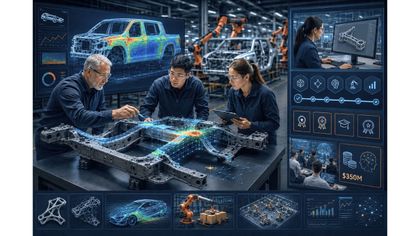
Luminary has launched Shift-Crash, a physics AI model for full-vehicle crash prediction. Built on 5,000 crash simulations based on a 2010 Toyota Yaris, it reportedly predicts deformation, stress fields and overall crash response in seconds rather than hours.
For context, official NCAP crash ratings are tightly defined test conditions, which is why fast AI crash prediction is best treated as early screening rather than certification evidence.
The target is early crashworthiness screening. DEVELOP3D reports that a typical NHTSA NCAP 56 km/h frontal crash simulation can take 10 to 12 hours on HPC clusters, while Shift-Crash uses transfer learning to carry crash physics knowledge between vehicle programmes and classes. Luminary claims prediction error below 3% RMSE.
The takeaway: AI crash models could let teams explore more structural options before designs become expensive to change. But crash safety is high-stakes engineering, so this should be treated as a fast screening and decision-support tool, not a replacement for detailed FEA, physical testing or certification evidence.
Read more here.
Found this briefing useful?
Subscribe for concise, practical updates on AI tools, workflows and signals shaping engineering design, simulation and manufacturing.