This week’s AI engineering brief looks at how AI is moving from hype into practical engineering workflows, including skills, CAD automation, product lifecycle tools and factory digital twins.
1. Career: AI Skills Gaps Start to Bite
ASME’s main finding is that engineers remain broadly optimistic about innovation, but AI skills are becoming a real bottleneck. A Specialist Staffing Group survey of nearly 5,400 STEM professionals found only 9% of U.S. respondents were pessimistic about their organisation’s ability to keep up with technology, but 32% of U.S. STEM professionals said improving staff AI skills is their biggest challenge.
The awkward detail is that AI adoption is already happening, often faster than company policy. ASME reports that more than half of surveyed STEM professionals use unauthorised AI tools weekly, while 22% of engineers worldwide say controlling staff use of AI is now an organisational challenge. The issue is not just training, but safe experimentation, approved tools, data security and governance.
The takeaway for engineering teams is practical: AI skills gaps are now a delivery risk, not a future HR problem. ASME’s source argues firms should audit workflows, combine hiring with upskilling, and give engineers approved AI sandboxes rather than leaving them to “shadow AI”. For mechanical engineers working with automation, digital twins and AI-driven design, the career signal is clear: learn the tools, but learn how to use them safely.
Read more here.
2. The Wider Signal: Agentic AI Is Useful, but Not Autonomous
A new MIT-backed paper examines how agentic AI is being adopted in engineering and manufacturing, based on interviews with large companies, SMEs, AI developers and CAD/CAM/CAE vendors. Unlike a basic chatbot, agentic AI can plan steps, call tools, interact with engineering software and adapt based on feedback.
The strongest near-term value is in structured, repetitive and data-heavy tasks, where results are easy to check and failure is manageable. The bigger opportunity is multi-step workflow automation across design exploration, simulation setup, manufacturing planning and decision support. But adoption is still limited by messy data, legacy software, security constraints and weak verification standards.
The takeaway for engineers is simple: agentic AI may become a useful coordinator across engineering tools, but it is not ready to run high-stakes work alone. Human validation, audit trails, AI literacy and governance remain essential. AI can help move the work along, but engineers still need to check the assumptions, outputs and consequences.
Read more here.
3. Tools: Autodesk Brings AI Into CAD Workflows
Autodesk has introduced MCP servers to connect AI agents with Autodesk tools, data and workflows. MCP, or Model Context Protocol, gives AI a structured way to interact with software, rather than just producing advice that engineers must copy across manually.
For mechanical design and manufacturing teams, the key update is the Fusion MCP Server. Autodesk says it can let AI interact with Fusion designs, build features, edit geometry and support design and manufacturing tasks. A Fusion Automation MCP Server also allows cloud-based access to Fusion’s design and manufacturing tools without a local installation.
The takeaway is that Autodesk wants AI to move from guidance into controlled execution. That could speed up repetitive CAD/CAM work, but permissions, security and review boundaries matter. Engineers still need to check the geometry, toolpaths, assumptions and downstream consequences.
Read more here.
4. Manufacturing: PTC Connects the Product Lifecycle
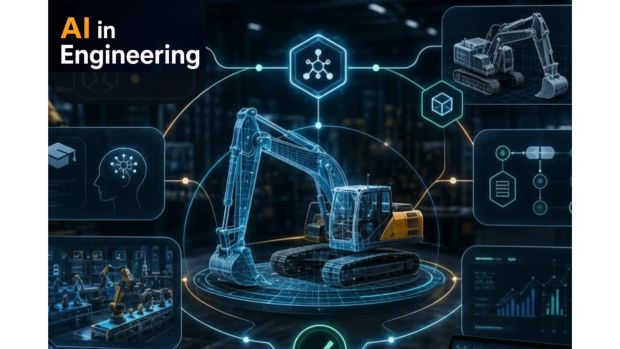
PTC is showcasing how Bobcat could use its “Intelligent Product Lifecycle” approach to connect requirements, design, manufacturing and service during the redesign of a compact excavator. Bobcat already uses Creo as its global CAD foundation, integrated with Windchill PLM, along with Arbortext for BOM-linked technical publications and Servigistics for service parts planning.
The demo links several PTC tools into one AI-enabled workflow. Requirements are defined in Codebeamer AI, the design is developed using Creo generative design, reviewed through the Windchill and NVIDIA Omniverse integration, and simplified with Windchill AI Parts Rationalization. ServiceMax AI then brings service insights back into engineering and support decisions.
The takeaway is that PTC is pushing AI as a lifecycle connector, not just a CAD feature. For engineering teams, the value is less rework, better change control and a clearer route from field data back into design decisions. The catch is familiar: the system is only as good as the product data, change discipline and engineering judgement behind it.
Read more here.
5. Siemens Pushes Factory Twins Into Operations
Siemens has unveiled Digital Twin Composer, a Siemens Xcelerator tool for building industrial metaverse environments using 2D, 3D and real-time operational data. Built with NVIDIA Omniverse libraries, it lets engineers test products, processes and factory changes virtually before touching the real system.
The standout example is PepsiCo, which is using the tool at selected U.S. manufacturing and warehouse sites. Siemens says the twins can model machines, conveyors, pallet routes and operator paths, helping teams identify up to 90% of potential issues before physical changes. Reported early results include a 20% throughput increase and 10 to 15% capex reductions.
The takeaway: Siemens is moving digital twins beyond visualisation and into operational decision-making. For engineers, the value is earlier problem-finding and better layout choices, but the twin still depends on clean data, sound assumptions and proper validation.
Read more here.
Found this briefing useful?
Subscribe for concise, practical updates on AI tools, workflows and signals shaping engineering design, simulation and manufacturing.