1. Tools: AI Agents Enter Engineering Software
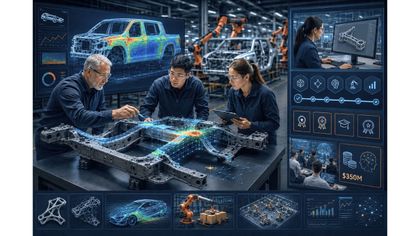
NVIDIA’s announcement shows GPU acceleration, AI agents and digital twins moving deeper into mainstream engineering software. Cadence, Dassault Systèmes, PTC, Siemens and Synopsys are building NVIDIA technology into design, simulation, verification and manufacturing tools used by major industrial customers.
For CAE teams, the headline is speed. NVIDIA says Honda is running Ansys Fluent aerodynamic simulations up to 34 times faster on Grace Blackwell than CPU-based runs, while Solar Turbines is completing billion-cell combustor simulations in 14 hours using Cadence Fidelity. Faster solves mean more design options before review gates.
The wider theme is workflow automation. AI-agent tools are being developed to help plan, optimise and verify complex engineering work, while PTC is linking Onshape data to NVIDIA Isaac Sim. The takeaway: AI can help engineers run more iterations and connect more tools, but setup, assumptions and judgement still belong to the engineer.
Read more here.
2. Design: Ansys Shows Where Simulation AI Helps
Synopsys has launched Ansys 2026 R1, with the main story being more joined-up Synopsys-Ansys workflows. For mechanical and design engineers, that means tighter links between simulation, materials data, embedded software, functional safety, electronics and system-level modelling, including QuantumATK connected with Ansys Granta MI.
The AI updates focus on reducing CAE friction. Ansys GeomAI helps explore early geometry concepts, Mesh Agent supports meshing diagnosis in Ansys Mechanical, and tools like SimAI Pro, Engineering Copilot and Discovery Validation Agent target setup checks, optimisation and faster simulation workflows.
The release also strengthens digital twins and system validation. Ansys TwinAI combines simulation, sensor and test data for real-time twin workflows, while Ansys CoSim supports distributed co-simulation. The takeaway: Ansys is becoming more connected, AI-assisted and system-aware, but engineers still own the assumptions, data quality and validation.
Read more here.
Related background: AI Copilots Are Rewiring Mechanical Design.
3. Manufacturing: Siemens NX CAM Shows Bounded AI
Siemens has introduced AI Make Machining Suggestion in NX CAM 2512, available with NX X Manufacturing. The feature adds AI-driven CAM recommendations to the existing Make Machining Suggestion workflow, helping CNC programmers create machining processes faster while staying close to established shop practice.
The user selects a face, and the system analyses the feature before generating three machining suggestions, including operations, tools and cutting parameters. Siemens says it uses large language models together with a company’s historical machining data, so recommendations can reflect previous programming choices, tooling preferences and internal standards.
The takeaway is that this is CAM automation with the programmer still in control. An expert chooses the best option, checks the logic and validates the result. Used well, AI MMS could help reduce programming time, improve consistency and make shop-floor machining knowledge easier to reuse.
Read more here.
4. Manufacturing: AI Vision Meets Factory Reality
AI vision is finding its place on automotive factory floors, but the key message is that the camera is only one part of the system. AMS highlights companies including 36ZERO Vision, phil-vision and aku.automation, who stress that reliable inspection depends on lighting, optics, sensors, PLC timing, image handling, model training and operator trust.
The main challenge is false positives. If the system keeps flagging harmless variation as defects, operators lose confidence quickly. AI vision is strongest where surfaces vary, defects are hard to define, or visual similarity matters. Traditional rule-based vision still works well for stable measurements and clear pass/fail checks, so hybrid systems are likely to remain important.
The takeaway is that AI vision is an engineering integration problem, not just an AI purchase. Brownfield factories bring legacy equipment, lighting constraints and data issues. The next step is using inspection data not only to detect defects, but to prevent them by feeding insight back into the process.
Read more here.
5. The Wider Signal: AI Governance Becomes a Management Issue
EU lawmakers and member states have reached a provisional deal to water down parts of the EU AI Act, including delaying rules for high-risk AI systems from August 2, 2026 to December 2, 2027. The deal still needs formal approval from EU governments and the European Parliament.
The key detail for engineering and manufacturing is that machinery would be excluded from the AI Act, because it is already covered by sector-specific rules. Reuters says this followed calls from companies including Siemens and ASML, and could reduce duplicate compliance work for industrial AI systems.
The takeaway: Europe is trying to ease AI red tape without abandoning regulation. For engineers, AI compliance is still very much alive, but machinery-related systems may sit more naturally within existing safety and product-rule frameworks. Validation, traceability and risk assessment remain essential.
Read more here.
Read more about ISO/IEC 42001 here.
Career: Learn the Tools, Protect the Judgement
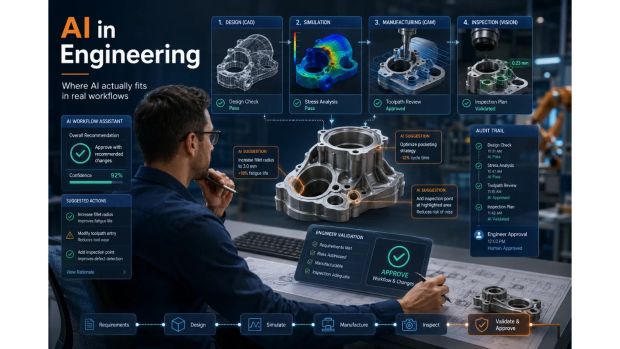
In the short term, engineers do not need to become AI specialists overnight. They need to become confident users and validators of AI-assisted tools for simulation, meshing, CAM, inspection and digital twins. The fundamentals matter more, because someone still has to judge whether the AI-generated result makes engineering sense.
Over the next few years, the strongest skills will be validation, data quality and connected workflows. CAE, CNC, quality and automation engineers will all need to guide AI systems while protecting tolerances, assumptions and proven shop practice.
Longer term, engineers will supervise intelligent systems that generate options faster than before. That favours people who can bridge design, simulation, manufacturing, data and safety. The career signal is clear: learn the tools, but protect the judgement.
Found this briefing useful?
Subscribe for concise, practical updates on AI tools, workflows and signals shaping engineering design, simulation and manufacturing.