1. Design: Dunlop and Fujitsu Speed Up Tyre CAE
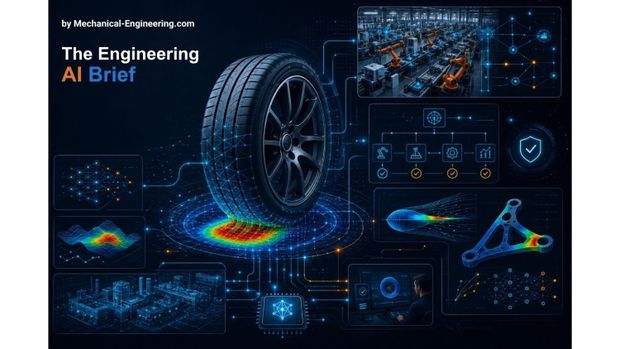
NVIDIA’s announcement shows GPU acceleration, AI agents and digital twins moving deeper into mainstream engineering software. Cadence, Dassault Systèmes, PTC, Siemens and SDunlop and Fujitsu have developed an AI surrogate model for tyre structural analysis, aimed at predicting performance much faster than conventional FEM workflows. In a proof of concept, the model reduced analysis time by around 90%, from about 45 minutes to 5 minutes, while handling roughly 600,000 mesh elements.
The model focuses on tyre deformation and road contact behaviour, including contact shape and pressure distribution. Built using a graph neural network trained on accumulated FEM results and Dunlop design data, it achieved an average 87.7% accuracy against FEM analysis for contact shape prediction.
The takeaway: AI surrogate modelling could help tyre engineers screen structures and materials faster before detailed CAE and physical validation. Dunlop aims to turn the work into a practical design support tool by April 2027, with Fujitsu also testing it on its energy-efficient FUJITSU-MONAKA processor. Engineers still need to validate the results, but the iteration loop could get much shorter.
Read more here.
2. Manufacturing: Plataine Targets Factory Firefighting
Plataine has launched a next-generation suite of conversational AI agents inside its Total Production Optimization platform. The agents are designed to move manufacturers beyond static dashboards by monitoring planning, scheduling, materials, assets, labour and execution in real time.
The practical aim is faster response when production gets disrupted. If materials are delayed, a machine goes down or labour availability changes, Plataine says its agents can identify the root cause, calculate a re-optimised plan and recommend recovery actions. Users can also run natural-language “what-if” scenarios before making changes on the live shop floor.
The takeaway: this is AI aimed at factory decision support, not isolated automation. It could help planners cut manual firefighting and improve delivery confidence, but the quality of the recommendations still depends on accurate production data, realistic constraints and human approval before changes hit the floor.
Read more here.
3. The Wider Signal: Siemens Orchestrates Industrial AI Agents
Siemens has launched Intelligence Center X, industrial AI orchestration software designed to move companies beyond isolated pilots. It connects industrial data, workflows and AI agents in a governed system, using Mendix, Graph Studio and AI Studio from the RapidMiner portfolio.
The aim is to embed AI agents into real engineering and manufacturing processes, with human-in-the-loop control, auditability and policy limits. Siemens says early deployments have delivered measurable gains, including an 85% reduction in production issue resolution time at Vivix and a 95% reduction in manual effort for an Axiz pricing use case.
The takeaway: Siemens is targeting the hard part of industrial AI, which is scaling it across real workflows rather than leaving it in demos. For engineers and operations teams, the value could be faster issue resolution and better decision support, but only if the underlying data, governance and process discipline are strong.
Read more here.
4. Manufacturing: Micron and MetAI Build Fab Twins
Micron and MetAI have developed simulation-ready fab twins using NVIDIA Omniverse libraries. The system uses MetAI’s MetGen platform to turn fragmented fab engineering data into structured digital environments for semiconductor manufacturing simulation and future AI-driven automation.
The workflow can convert CAD drawings and facility metadata into parametric, modular, SimReady digital twins, including large cleanroom production areas. Built on OpenUSD, the twins are intended to support layout planning, design validation and material flow analysis before changes are made in the real fab.
The takeaway: this is digital twin work aimed at high-stakes manufacturing environments, not just visualisation. The link to NVIDIA Isaac Sim also points toward robotics simulation, synthetic data generation and real-to-sim-to-real validation. For engineers, the value is earlier testing and better planning, but the twin still depends on clean data, accurate facility models and disciplined validation.
Read more here.
5. The Wider Signal: PhysicsX Scales Physics AI
PhysicsX has raised a $300 million Series C at a reported valuation of around $2.4 billion, led by Temasek with participation from investors including NVIDIA, Siemens and Applied Materials. The funding will support global growth, platform expansion and development of larger pre-trained Large Physics Models.
The company’s focus is AI that predicts physical behaviour in seconds rather than hours or days, helping engineers explore far more design variants than traditional simulation workflows allow. PhysicsX says its platform is already used across aerospace and defence, semiconductors, automotive, industrial machinery, energy and materials.
The takeaway: physics AI is becoming a serious industrial investment area, not just a research idea. It could make simulation insight available earlier and to more people across engineering and manufacturing. But faster prediction is still not the same as validated engineering evidence, so teams will need clear checks against CAE, test data and real operating conditions.
Read more here.
Found this briefing useful?
Subscribe for concise, practical updates on AI tools, workflows and signals shaping engineering design, simulation and manufacturing.