
1. Jeff Bezos Wants to Build an "Artificial General Engineer"
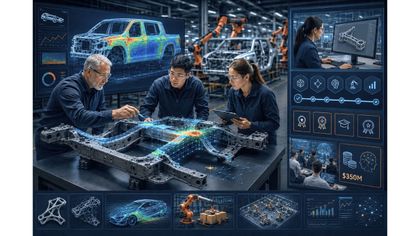
Prometheus, the industrial AI startup backed by Jeff Bezos, just raised $12 billion at a $41 billion valuation. The pitch? Compress the entire journey from idea to manufactured product — jet engines, medical devices, consumer electronics — using AI. They're calling the target an artificial general engineer.
That phrase should set off a few alarm bells. Because right now, Prometheus is a colossal funding round in search of a working product. The real question isn't whether the demos are impressive — it's what data the AI was trained on, what assumptions are baked in, and who's accountable when the tolerances don't line up. Watch for customer deployments, training data transparency, and evidence this works on something messier than a clean CAD file.
Giant ambition, giant money — still no proof it survives a Monday morning at a real factory.
Read out take on this story here.
2. Limitless Labs to Cut CNC Programming Time in Half
Limitless Labs (formerly LimitlessCNC) just raised $20 million to scale its agentic AI platform for CAD/CAM. The headline claim: up to 50% reduction in CNC programming time. The platform is already in production with Sandvik and Iscar, and works inside tools you likely already use — Mastercam, NX, Creo.
Feed it a CAD file and the CAM Agent identifies features, recommends tooling, sequences operations and generates toolpaths — all while keeping you in the loop. This is one of the more credible AI-in-manufacturing stories right now, because it targets a genuine bottleneck: critical CAM knowledge locked inside a handful of senior programmers' heads.
Promising, but it needs to prove it handles awkward parts, unusual fixtures, worn tooling and real shop-floor chaos — not just clean demo files.
Read more here.
3. PTC Wants AI to Spot Product Problems Earlier
PTC has launched Orbit, AI software meant to pull together design, service and customer data about products already in use. PTC says it cleans up records from engineering, service, sensors and business systems so teams can ask better questions.
This is not flashy CAD AI. It is about getting field failures, spare-part demand and service patterns back to the people who design and support the product. That could help teams spot repeated problems before they become expensive rework or customer pain.
Useful if Orbit turns messy service data into evidence engineers can trust, not just prettier dashboards.
Read more here.
4. Sight Machine Wants Factory Workers Running AI
Sight Machine has launched an AI manufacturing platform that lets process engineers build and interrogate a living model of their plant — without needing a specialist data team to set it up. Agents pull together data from across the factory floor — sensors, production records, maintenance history, operating procedures — then investigate quality drift, downtime and yield gaps. Findings get pushed to Teams, Excel or floor displays for review.
The big idea is putting AI in the hands of the people who actually know the plant. That's the right instinct. The hard part is whether agents handle messy real-world data and human approval without generating confident-sounding nonsense at speed.
Useful if proven. Dangerous if confident recommendations outrun plant reality.
Read more here.
5. Plans for AI in Advanced Manufacturing
The UK government has published an AI adoption plan for advanced manufacturing. The plan says manufacturers need a clearer route from interest to real use: scan the opportunity, run a small test, then scale only what works.
That matters because factory AI usually fails in the boring bits: old machines, patchy data, weak business cases, skills gaps and safety worries. The plan is useful because it talks about test sites, validation and support for smaller manufacturers.
Not a tech breakthrough — a deployment roadmap.
Read more here.
6. Genesis AI Builds Eno
Genesis AI is a robotics lab building general-purpose robots, and its new Eno robot is interesting because it avoids the usual humanoid theatre and focuses instead on “human capability, not human form.” The use case is extending skilled human work into places where hands, time or safety are limiting, from lab tasks and assembly-style handling to awkward real-world manipulation.
Found this briefing useful?
Subscribe for concise, practical updates on AI tools, workflows and signals shaping engineering design, simulation and manufacturing.