1. Ford Discovers Veteran Engineers Are Useful. Who Knew?
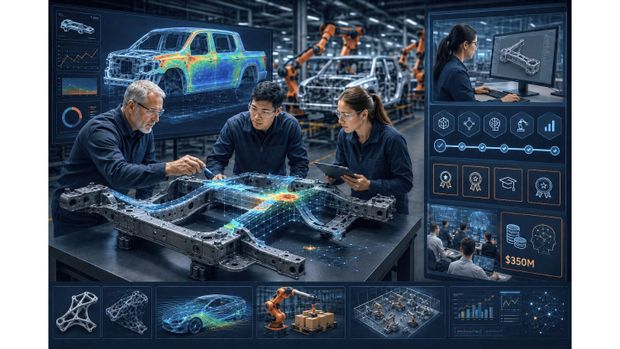
Ford has topped J.D. Power’s 2026 Initial Quality Study among mainstream brands, its first win there since 2010. Nice result, and not a small one. But the juicier bit is how Ford says it got there: by hiring, promoting or bringing back about 350 experienced technical specialists.
Ford says its quality reset began in 2023. Since then, it has added about 350 experienced technical specialists while using AI to catch defects earlier. Business Insider reports Ford executives admitted AI and automation were not enough on their own. AI can flag patterns and risks. Veteran engineers know where failures hide, why they repeat and which “minor” issue becomes a warranty nightmare.
Read more here.
2. Autodesk Puts $350 Million Behind AI Skills for Design and Manufacturing Jobs
Autodesk’s AI Jobs Report 2026 says AI-related roles across architecture, engineering, construction, product design and manufacturing have grown 147% in two years, with 33% growth in the past year alone. Autodesk is backing that trend with a $350 million, three-year push covering AI training, software access and certifications.
By the end of 2028, Autodesk says it will train nearly one million people and support more than 200,000 industry-recognised certifications. The programme includes training for professionals as well as students, with certifications that cover design and manufacturing workflows.
Read more here.
3. Siemens Wants AI to Create First Design Concepts
Siemens says Simcenter PhysicsAI Generate, available in Simcenter Hypermesh 2026.1, can create physics-aware 3D concepts from dimensional targets and performance goals. It is trained on old designs and simulation results, then proposes fresh geometry in seconds instead of starting with a blank CAD screen.
The example is an electronics housing. Siemens says the tool produced a new housing concept in under 10 seconds for width, length and displacement targets.
Read more here.
4. GM Says AI Is Speeding Up the Hard Part of Vehicle Validation
GM’s strongest AI claim is about speed in vehicle testing. The company says machine learning and simulation can cut roof-crush analysis from 8 to 40 hours down to less than five minutes, giving engineers more chances to compare design options before building physical prototypes.
That matters because vehicle design is a constant balancing act between strength, weight, aerodynamics, software and manufacturing cost. Faster simulation can help teams spot weak ideas earlier, but GM is right to keep physical testing in the process. A faster model is only useful when engineers understand what it proves, what it assumes and what still needs to be tested in the real world.
Read more here.
5. Doosan Shows an AI Palletiser Built for Faster Changeovers
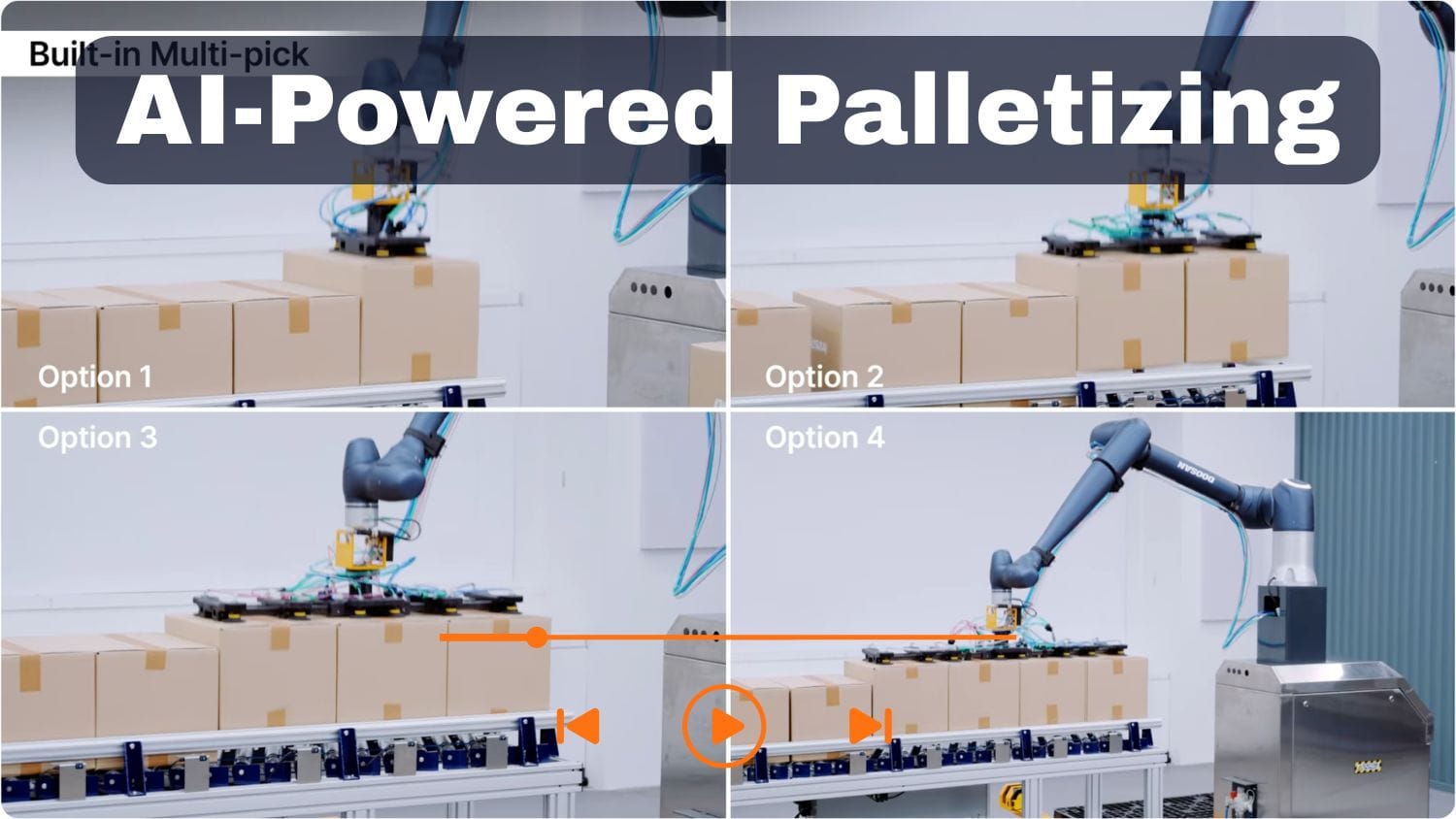
Doosan Robotics has unveiled PalletizHD+, an AI-powered palletising system for Automate 2026. The company says it can process up to 11 boxes per minute, optimise robot travel paths before operation and let users enter box and pallet details so the software can generate stacking patterns automatically.
Palletising is easy to describe and awkward to automate well. Box sizes change, packaging quality varies and end-of-line layouts are rarely perfect. The useful engineering question is whether AI setup tools can shorten changeovers without creating new reliability problems when real products, operators and production pressures get involved.
6. Vention and Teradyne Aim to Make UR Robot Cells Easier to Prove Before Build
Vention and Teradyne Robotics have announced a digital cell-design platform for Universal Robots deployments. Built around Vention’s MachineBuilder technology, it lets users design, program and simulate modular robot cells in one virtual workspace before moving to the physical installation.
That targets a real automation problem. The expensive part is often not the robot arm, but the cell around it: reach, fixtures, access, guarding, grippers, part variation, recovery routines and operator interaction. Digital checks can reduce rework, but engineers will still want cycle-time proof on real parts and realistic handling conditions.
Read more here.
7. AVEVA Wants Factory AI to Start With Better Plant Data
AVEVA used AVEVA World 2026 to announce AI-enabled updates across CONNECT, Operations Control, Unified Engineering and PI Data Infrastructure. The practical message is that AVEVA wants plant data, engineering data and operator information to become easier for AI tools to use without forcing teams to rebuild every system.
For manufacturing engineers, this is really a data-quality story. AI tools are only useful when tags, assets, alarms, process history and engineering context line up. Old naming conventions, missing metadata and plant-floor exceptions will still cause trouble. Useful factory AI starts with trustworthy data.
Read more here.
8. Siemens NX Adds AI CAM Suggestions That Ignore Old Shop Habits
Siemens has updated NX X Manufacturing 2606 with a new generative AI option inside AI Make Machining Suggestion. Earlier suggestions relied on historic machining data and existing tool libraries. The new option can analyse feature geometry from scratch and create a parametric tool definition when the right tool is not already available.
For CAM programmers, that is useful because proven shop practice can also become a rut. A fresh suggestion may reveal a better route for cycle time, finish or tool life. But this is not CAM autopilot. The programmer still has to check the operation, tool choice, cutting data, clearances, fixturing and what the machine can actually do.
Read more here.
Found this briefing useful?
Subscribe for concise, practical updates on AI tools, workflows and signals shaping engineering design, simulation and manufacturing.